
Baby Tee
DTF vs DTG Printing
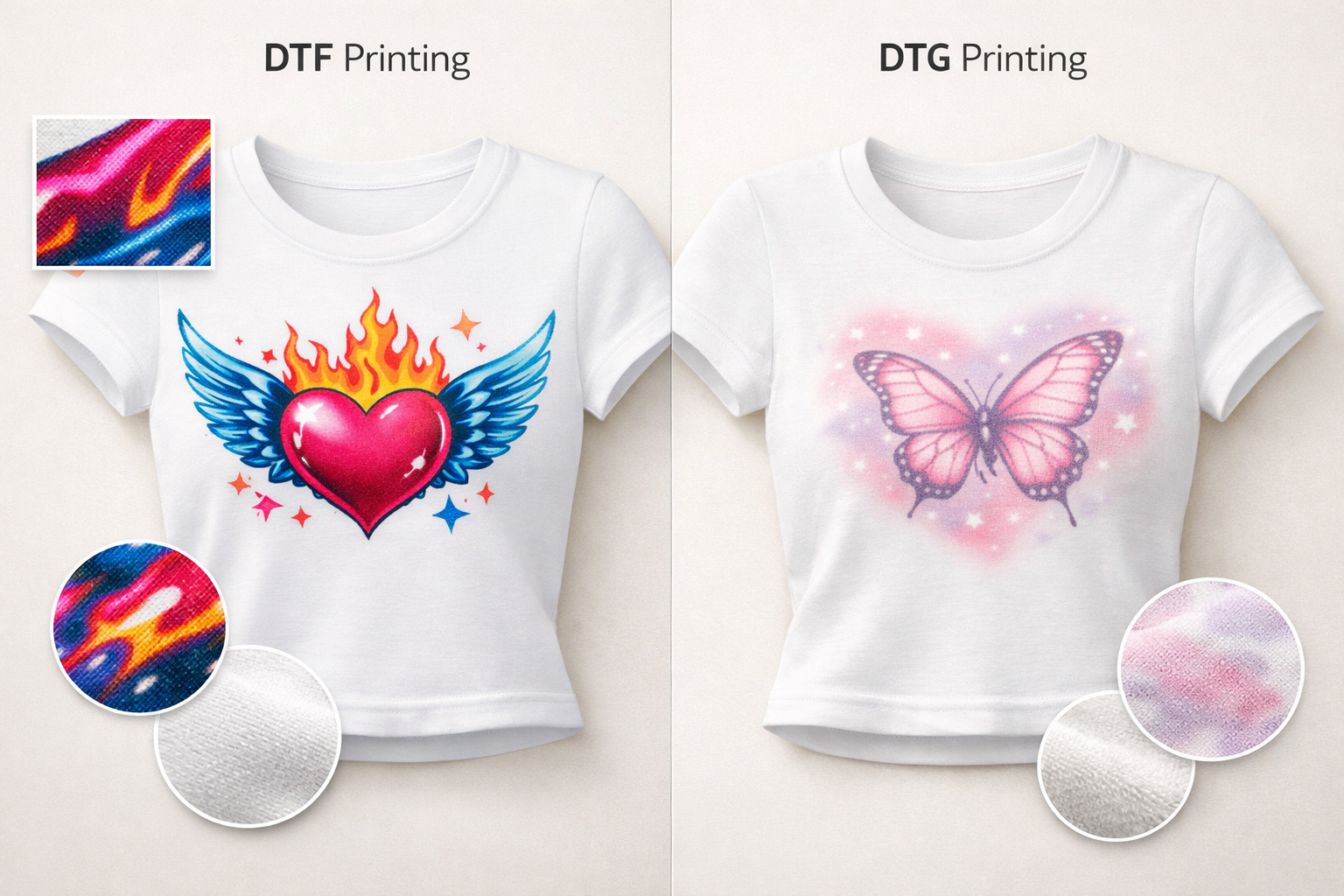
DTF vs DTG Printing:
What Buyers Need to Know.
The clear comparison between DTF and DTG printing for baby tees — which method works best for different designs, how they hold up over time, and what to check before ordering.
⚡ THE ANSWER IN ONE PARAGRAPH
DTG (Direct-to-Garment) prints ink directly into fabric fibres — best on 100% cotton, produces a soft breathable print, excellent for photo-realistic images. DTF (Direct-to-Film) transfers a printed film onto the fabric surface — works on more fabric types, produces vivid saturated colour, excellent for bold graphics and fine-line detail. Neither is universally better. The right method depends on the design type and the fabric blank.
📋 CONTENTS
How DTG Printing Works
DTG (Direct-to-Garment) printing works like an inkjet printer for fabric. Specialised water-based inks are applied directly onto the fabric surface, then the garment goes through a heat press or curing process that bonds the ink into the fabric fibres.
The result: a print that is part of the fabric rather than sitting on top of it. It has a soft hand feel — you can feel the texture of the fabric through the print. The print breathes with the garment. On 100% cotton, the inks absorb fully; on polyester blends, they sit more on the surface and produce less vibrant results.
DTG — STRENGTHS
- Soft, breathable print — becomes part of the fabric
- Excellent for photographic images and skin tones
- No print height — completely flat against the fabric
- Gets softer with washing on 100% cotton
- No minimum order quantity for most providers
DTG — LIMITATIONS
- Requires 100% or high-cotton-content fabric for best results
- Lighter colours print better than dark on dark fabrics without pre-treatment
- Vibrant colours can be slightly less saturated than DTF
- Requires proper fabric pre-treatment for dark garments
How DTF Printing Works
DTF (Direct-to-Film) printing works in two stages. First, the design is printed onto a special release film using specialised inks. Second, the printed film is heat-transferred onto the garment surface using a heat press, bonding the design to the fabric.
The result: a print that sits slightly on top of the fabric surface — you can feel a slight raised texture on complex designs. DTF produces exceptionally vibrant, saturated colour because the inks don’t need to absorb into the fabric. Fine-line detail and small text are more precise in DTF than DTG. And crucially, DTF works on almost any fabric type — cotton, polyester, blends, and even some performance fabrics.
DTF — STRENGTHS
- Works on virtually any fabric type — cotton, polyester, blends
- Exceptionally vibrant, saturated colour output
- Excellent for fine-line detail and small precise elements
- Strong on dark garments without pre-treatment
- Sharp white ink on any base colour
DTF — LIMITATIONS
- Slight raised feel on complex designs — not as flat as DTG
- Can feel stiffer than DTG on large print areas
- Sensitive to high heat — hot wash and high dryer settings degrade the film layer
- Less suited for vintage or faded-print aesthetics
Side-by-Side Comparison
| Factor | DTG | DTF |
|---|---|---|
| How it works | Ink printed directly into fabric fibres | Film printed then heat-transferred onto fabric |
| Feel on fabric | Soft, flat, part of the fabric | Slight surface texture, especially on dense designs |
| Best fabric | 100% cotton — strongly preferred | Works on cotton, polyester, blends, and more |
| Colour vibrancy | Very good — slightly muted on dark bases | Excellent — vivid on any base colour |
| Photo realism | Excellent — best method for portraits and skin tones | Good — very precise but slight film texture |
| Fine-line detail | Good | Excellent — sharper at small sizes |
| White ink | Requires pre-treatment on darks | Strong on any base without pre-treatment |
| Wash durability | Long-lasting on cotton with cold wash + air dry | Long-lasting — avoid high heat specifically |
| Vintage/faded look | Natural — inks soften with washing | Less natural — film layer resists the faded effect |
| Eco footprint | Water-based inks, no film waste | Film carrier generates waste |
Which Method for Which Design?
The design type is the primary factor in choosing between DTF and DTG. Use this as your reference:
| Design type | DTG | DTF |
|---|---|---|
| Portrait / photo realistic | ✅ DTG preferred | Works — less natural skin tone |
| Bold graphic, flat colours | Works well | ✅ DTF preferred — more vivid |
| Fine-line text or detail | Works at larger sizes | ✅ DTF preferred — sharper |
| Vintage / faded aesthetic | ✅ DTG preferred — inks soften | Less suited |
| White graphic on dark base | Requires pre-treatment | ✅ DTF — strong without pre-treatment |
| Full-colour complex design | ✅ DTG on cotton | Both work — DTF slightly more vivid |
| Standard slogan / phrase | Both work equally well | Both work equally well |
For most DialUpDolls-style graphic baby tees — bold Y2K graphics, digital-aesthetic designs, statement phrases — both DTF and DTG produce excellent results. The difference becomes meaningful for portrait photos (DTG preferred) or ultra-fine-detail designs (DTF preferred). When ordering custom tees, always ask the seller which method they use and confirm it matches your design type.
Fabric Compatibility
Fabric choice affects both methods significantly:
For DTG: 100% ring-spun cotton is the gold standard. Cotton-poly blends (60/40 or higher cotton) are acceptable but produce less vibrant results. 100% polyester or synthetic fabrics do not work well with DTG — the inks don’t absorb properly and vibrancy is significantly reduced.
For DTF: Works on cotton, polyester, cotton-poly blends, nylon, and most other fabric types. The film adhesion works regardless of fibre type. This makes DTF the practical choice when printing on poly blends or when fabric type is variable across an order.
DialUpDolls baby tees use 100% soft cotton blanks — both methods produce excellent results on this fabric. For custom orders, confirming the blank material with the seller ensures the print method is optimised for the specific fabric in your order.
Wash Durability & Care
Both DTG and DTF prints last for years under correct care. The primary threats are the same for both: high water temperature, high dryer heat, and abrasive washing. The care rules are identical:
DO THIS
- Wash inside-out in cold water (30°C / 86°F maximum)
- Air-dry flat or tumble-dry on low heat only
- Use a pressing cloth if ironing — never iron directly over the print
- Use mild detergent without bleach
AVOID THIS
- Hot water wash — primary cause of print degradation for both methods
- High dryer heat — DTF film layer is especially temperature-sensitive
- Direct ironing over the print
- Bleach or harsh chemical detergents
The main difference in durability between the two: DTG prints on 100% cotton tend to soften and develop a slightly vintage feel after many washes — which most wearers consider a feature. DTF prints maintain a more consistent appearance over time but are more sensitive to heat damage if care instructions are ignored.
What to Ask Before Ordering a Custom Baby Tee
When ordering a custom or personalised baby tee, three questions determine print quality:
The method should match your design type. Photo-heavy or portrait images → ask for DTG on cotton. Bold graphics or fine detail → DTF works well on either fabric.
DTG requires 100% cotton for best results. DTF works on any fabric but cotton still produces the best overall feel. If the seller doesn’t specify, ask.
Especially important for DTG photo tees where image resolution matters. A mock-up preview catches resolution and layout issues before the tee is made.
DialUpDolls Baby Tees — Quality Printed to Order
265+ designs across 13 channels. $29.99 each on 100% soft cotton. Every tee printed to order — the right method for every design.
FAQ — DTF vs DTG Printing
What is the difference between DTF and DTG printing?
DTG (Direct-to-Garment) prints ink directly into the fabric fibres — best on 100% cotton, produces a soft breathable print. DTF (Direct-to-Film) transfers a printed film layer onto the fabric surface — works on more fabric types and produces vivid, high-saturation colour. Both methods produce quality results when applied correctly.
Which is better for baby tees — DTF or DTG?
It depends on the design. DTG is better for photo-realistic images and skin tones on 100% cotton — the ink absorbs into the fabric for a soft feel. DTF is better for bold, vibrant-colour graphics and fine-line detail on any fabric. Most DialUpDolls-style graphic baby tees work well with either method.
Does DTF printing crack or peel?
Quality DTF prints do not crack or peel under normal wear when cared for correctly. Wash inside-out in cold water and air-dry or tumble-dry low. High heat is the primary cause of DTF film degradation — avoid hot washes and high dryer settings.
Is DTG printing permanent?
DTG prints are permanent when cared for correctly — wash cold, inside-out, air-dry or low heat. DTG prints on 100% cotton typically soften slightly with washing, which is considered a feature rather than a defect. Avoid bleach entirely.
What fabric works best for DTG printing?
100% cotton is the gold standard for DTG printing. The ink absorbs into natural cotton fibres more completely than into polyester or synthetic blends, producing better colour saturation, softer feel, and longer print life. Cotton-poly blends (50/50) produce adequate but noticeably less vivid DTG results.
What fabric works best for DTF printing?
DTF works on a much wider range of fabrics than DTG — cotton, polyester, poly-blend, nylon, and even some performance fabrics. This makes DTF more flexible across blank types, though print feel is slightly more surface-level than DTG on cotton.
How long do DTF and DTG prints last?
Both methods last several years under correct care. DTG prints on 100% cotton: wash after wash with minimal visible degradation if cold-washed and air-dried. DTF prints: highly durable under normal care; avoid high heat as the film layer is sensitive to temperature.
